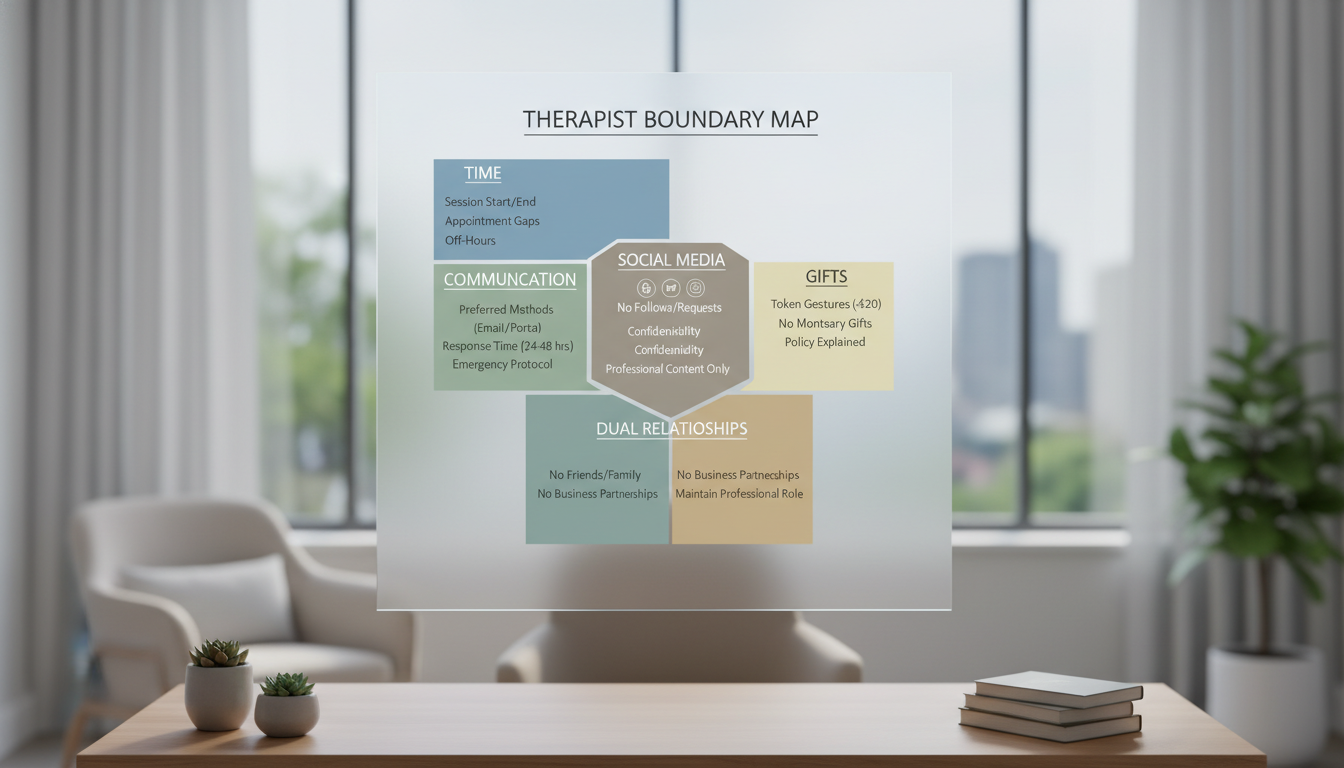
Key Takeaways

  • Strong therapeutic boundaries create safety and trust for both client and clinician, and they keep your work grounded in clear ethics

  • Modern practice adds new boundary risks through social media, texting, and telehealth where expectations can get blurry fast

  • Clear policies, consistency, and supervision reduce violations and burnout, and they lower the chance of serious professional consequences

When a client asks to connect outside session and you feel the pull to say yes

A client ends a strong session and says, “Can I add you on Instagram?” or “Do you want to grab coffee sometime?” In the moment, it can feel like a quick, harmless yes, especially if you want to support rapport or you sense the client might feel rejected.

That said, that one yes can create instant complexity: what you do if they message at 11 p.m., comment on your family photos, or expect faster replies than your usual turnaround. Boundary issues are a leading driver of complaints and poor outcomes, and unclear boundaries can increase dropout risk by around 20%, because the client may feel confused about what the relationship is and what care they can count on.

By the end of this section, you’ll be able to name the core boundary domains and use a repeatable way to respond in real time without sounding cold. Think of boundaries as what stays consistent even when the client’s needs, risk level, or attachment pull changes.

Core boundary domains to keep clear (so you can respond quickly):

  • Communication: where messages go, response times, and what counts as urgent

  • Time: session length, late cancellations, and after-hours contact

  • Place: meeting locations and what is and is not a therapy setting

  • Money: fees, billing questions, and payment exceptions

  • Roles: therapist vs friend, mentor, advocate, or business contact

  • Privacy: social media contact, online visibility, and what you share about yourself

If you do one thing, do this: pause before answering and name the domain out loud. For example, “I hear you want to stay connected between sessions. Let’s talk about what support looks like between appointments and the best way to reach me.”

Common mistake: explaining too much or apologizing until it sounds negotiable. Fix: keep it warm, brief, and specific, then offer an approved alternative (for example, secure messaging during set hours, a check-in slot, or a crisis line for emergencies). Works best when you state the boundary early and consistently; it tends to fail when you make exceptions in the first 2 to 4 weeks, because the client learns a different rule than the one you plan to follow.


What boundaries actually are and why they strengthen the therapeutic alliance

Next, it helps to name what a boundary is in therapy: a clear limit that protects the purpose of treatment and the safety of everyone in the room. Boundaries are not about being cold or distant. They are about creating a consistent clinical frame so the client knows what to expect each week.

You can think of boundaries in a few practical domains that shape the frame:

  • Time: start and end times, late arrival policy, between-session contact windows, response times

  • Space: where sessions happen, privacy rules, telehealth location expectations, who can be present

  • Emotional intimacy: how much personal disclosure you share, how you handle caretaking pulls, how you respond to gifts or special requests

  • Roles: therapist role versus friend/coach/parent, what you can and cannot do outside therapy, how decisions are made in the work

Also, strong boundaries usually increase trust because they reduce ambiguity. Clients often test limits when they are anxious, attached, dysregulated, or used to relationships that change rules without warning. When you hold a steady frame, you are giving them predictability, and predictability is a form of protection.

Boundaries strengthen the therapeutic alliance because they support:

  • Client protection: fewer grey areas where the client feels responsible for you, worries about rejection, or wonders what they “owe” you

  • Consistency and predictability: the work feels reliable, which can lower vigilance and help the client take more interpersonal risks in session

  • Therapist objectivity: clear limits reduce role confusion and help you notice countertransference, meaning your emotional reactions to the client

  • The unique purpose of therapy: the relationship is not mutual in the same way as friendship, because it is designed to serve the client’s goals, not both people’s needs

If you do one thing, do this: treat boundaries as part of the treatment plan, not a personal preference. They help you stay steady, and they help the client feel safe enough to do the hard work.

The most common boundary pressure points in modern practice

Next, it helps to name the situations that repeatedly create boundary pressure, so you can respond with a plan instead of in the moment. Most boundary strains now show up in day to day micro requests: a late night text, a friend request, a small gift after a tough session, or a casual “Can we do a quick call today?” that turns into a pattern.

The common thread is availability. If you do one thing, define what “reachable” means in your practice, including what happens when you are not reachable, so clients do not have to guess and you do not have to renegotiate every week.

Here are the dilemmas that come up most often, plus a simple way to pre decide your stance:

  • Social media: follows, friend requests, comments, tagging, seeing client content

  • Electronic communication: texts vs email, response time, crisis messages, attachments, screenshots

  • Gifts: small tokens, expensive items, handmade gifts, holiday tipping, “just this once” exceptions

  • Dual relationships: overlapping communities, referrals from friends, attending the same events, bartering

  • Availability creep: same day scheduling, after hours messages, “quick question” requests, session overrun of 5 to 15 minutes

Works best when you decide your default rule and your one exception rule. Fails when decisions are made case by case without a stated reason, because clients experience it as unpredictable or unequal.

So, split what you communicate into two layers: what clients need to know up front, and what your team needs to follow consistently.

Put in informed consent (client facing, plain language):

  • How to contact you between sessions and typical reply window, such as within 1 business day

  • What channels you use, such as client portal only, email for scheduling only, no texting

  • What is and is not an emergency contact plan, including what to do after hours

  • Your social media policy in one sentence, such as “I do not connect with clients on social media”

  • A simple statement about gifts and boundaries, such as “I may not be able to accept gifts”

Put in written policies and protocols (your internal consistency):

  • Exact response time targets and who covers when you are out, such as a voicemail script plus referral numbers

  • A decision tree for gifts, including value thresholds and how you document the decision

  • A dual relationship checklist, including when you consult and how you record the rationale

  • A scripting bank for common moments, such as ending a session on time and declining a follow

  • Documentation prompts, such as where you note boundary crossings and your clinical response

Common mistake: putting every edge case in informed consent, which overwhelms clients and still does not guide your real time calls. Fix: keep informed consent short and stable, and keep your detailed protocols where you can update them as new tech and new situations show up.

A practical boundary maintenance playbook you can use from intake onward

In practice, boundary issues are easier to prevent than to repair after a rupture. The goal is not to feel less empathy, but to make expectations so clear that neither you nor the client has to guess what is ok when emotions run high.

If you do one thing, do this at intake: name the rules for contact, emergencies, session structure, and roles in plain language, then check understanding. For example, you might cover expected response times (for example, within 1 business day), what counts as an emergency (and what to do instead of texting you), and what happens if a client arrives late or wants to extend time.

Next, use a repeatable system to reduce “just this once” drift, especially when you are tired, busy, or feeling protective of a client. Keep it simple:

  • Consistency: use the same response pattern every time (for example, acknowledge, restate the policy, offer the next session time)

  • Self-awareness: note your pull to rescue, soothe, or avoid conflict, then pause before replying

  • Documentation: record boundary-related contacts and your response the same day, including any risk screening you did

  • Technology protocols: set separate work accounts, turn off read receipts, and avoid personal social media connections

A common mistake is making exceptions without naming them, then feeling trapped when the client expects the new pattern. The fix is to label any exception as a one-time choice, write the reason in your notes, and restate what happens next time (for example, “For future messages, please use the client portal and expect a reply during business hours”).

Closing remarks

Boundaries aren’t walls; they’re the frame that makes healing possible. They protect your client from role confusion and protect you from slow drift into over-responsibility, especially when the work is intense and the relationship feels meaningful.

Next, pick one place your boundaries are most likely to blur this month, then decide on one simple policy or script you will follow every time. For example, you might choose a 24-hour response window for non-urgent messages, a clear “I don’t connect on social media” line, or a plan for how you will respond when a client asks for contact between sessions.