New: Psyched to Practice is teaming up with Guilford Press to bring you new books, authors, and CE opportunities.

Key Takeaways

  • High-quality continuing education improves client outcomes, not just your credit count

    If you do one thing, choose CE that changes what you do in a 50-minute session, not just what you can list on a renewal form. A 6-hour training that gives you one repeatable skill you apply next week often beats a scattershot set of short webinars you never revisit

  • Use clear learning objectives and quality markers to choose training that fits your practice

    Next, scan the course description for specific objectives (for example, “write a case formulation” or “practice a grounding script”) and teaching methods (case examples, role-plays, feedback). Works best when the content matches your caseload, like trauma stabilization for a therapist seeing panic and dissociation, and fails when it stays at the level of broad overviews

  • Plan for implementation so new skills transfer into sessions and supervision

    That said, the course is only half the work because skills fade fast without a plan. If you’re short on time, pick one technique, schedule 2 client tries in the next 7 days, and bring a short debrief to supervision about what landed, what didn’t, and what you’ll adjust

When CE feels like a checkbox instead of real growth

Picture the end-of-cycle scramble: you’re counting credits, searching email confirmations, and signing up for “anything that fits” just to be done. Then you get to your next week of sessions and realize your case conceptualization, your wording, and your interventions look almost exactly the same.

A common reason is that the learning stayed in the webinar tab instead of making it into your actual work. As a simple benchmark, many clinicians stop using new techniques within about 2–4 weeks when there’s no implementation plan for how to try it, track it, and adjust it.

By the end of this post, you’ll be able to evaluate the quality of a CE experience and build a simple learning plan that supports real changes in session. You’ll be choosing CE based on what it helps you do with clients, not just what it helps you finish on a reporting form.

Start with your clinical reality, not the course catalog

Next, flip the usual process. Instead of scrolling a catalog and picking whatever looks interesting, start with what keeps showing up in your sessions and where you feel least steady.

Write down your patterns for the last 4 to 6 weeks. Look for the client concerns you see most, moments you tend to avoid or rush, and populations you want to serve better. For example, a therapist in community mental health might notice frequent crisis planning and substance use, while a school-based clinician might see anxiety, attendance issues, and parent consults.

Then turn those notes into 2 to 3 learning objectives that can guide every CE purchase. Keep them specific enough that you can tell if a training matches, and practical enough that you can use them within 2 to 4 sessions.

  • Pick your top 1 to 2 recurring client challenges (for example: panic, trauma triggers, self-harm, OCD)

  • Name the skill gap (for example: exposure planning, safety planning, case formulation, measurement-based care)

  • Identify the populations you serve or want to serve (for example: adolescents, perinatal clients, couples, autistic adults)

  • Write 2 to 3 learning objectives, each starting with an action verb like “assess,” “plan,” or “practice”

If you do one thing, do this: only enroll in CE that clearly maps to at least one objective. The tradeoff is that this works best when your caseload is fairly consistent, but it can fail when your weeks are unpredictable. If that’s you, set one “core” objective (skills you use with almost everyone) and one “flex” objective you can rotate quarterly.

A common mistake is writing objectives that sound broad but do not change decisions in session, like “learn more about trauma.” Fix it by making the outcome observable, such as “create a first-session stabilization plan and choose one grounding skill to practice between sessions,” or “build a simple exposure hierarchy and assign one between-session task with clear safety checks.”

How to spot high-quality training before you enroll

Next, treat enrollment like a quick due diligence step, not a leap of faith. A solid CE should make clear who is teaching, what evidence the content is based on, and how you will prove you can actually use the skill in session.

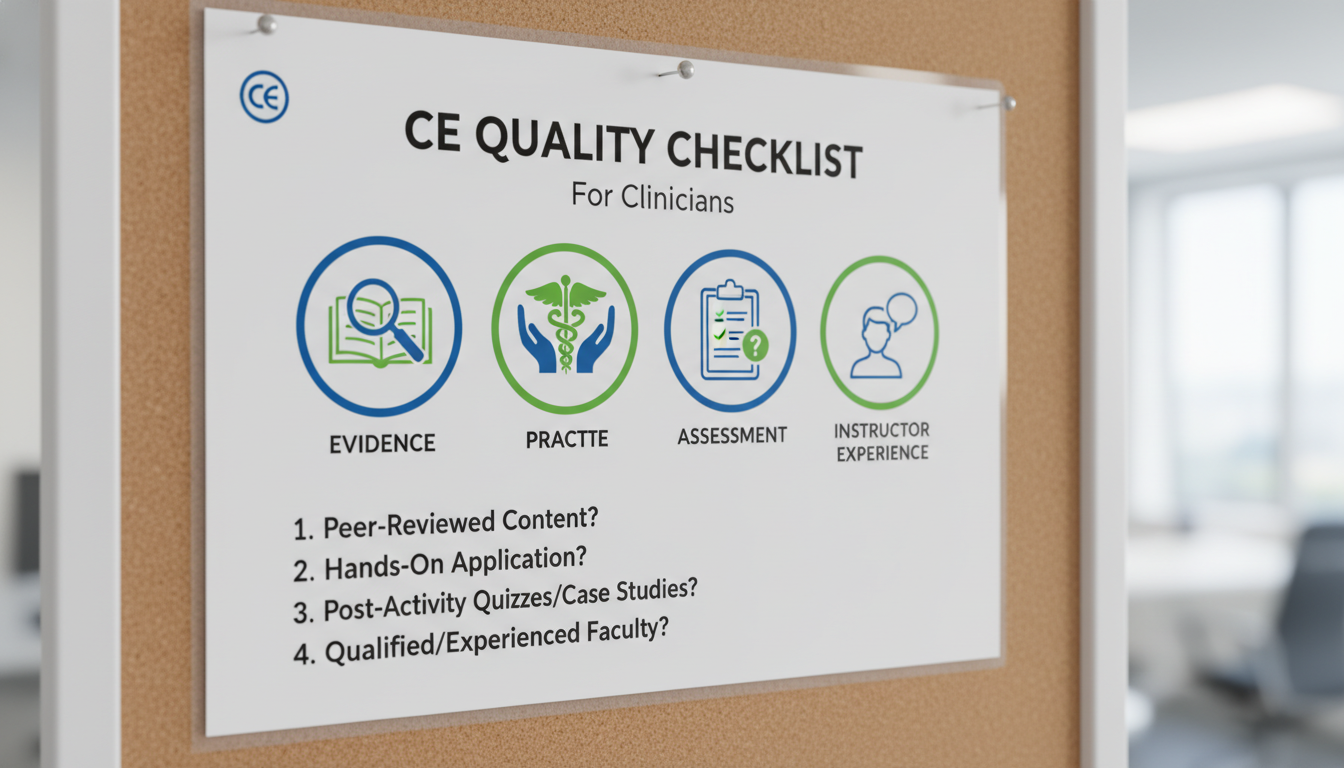
Use this fast checklist before you pay:

  • Instructor clinical expertise: recent real-world caseload or supervision experience, not only titles

  • Evidence-based content: cites current research and fits a defined model (for example CBT, ACT, EMDR)

  • Meaningful assessment: you practice a skill and get evaluated, not only a multiple-choice quiz

  • Clear learning outcomes: specific behaviors you should be able to do in 30 to 60 minutes of a session

  • Fit for your setting: names relevant populations (for example adolescents, perinatal clients, trauma cases) and common constraints (brief sessions, high acuity)

Common mistake: choosing a training because it promises “advanced” techniques but never shows how you will practice. Fix it by looking for a sample agenda or syllabus that includes skill reps, scoring rubrics, or required consultation hours.

Also, pay attention to how interactive the learning is, because passive watching rarely changes your behavior under pressure. Interactive components take more time, but they work best when you want a skill you can use next week; they fail when you only need a quick update on ethics or policy.

Prioritize these elements if you do one thing:

  • Practice: role-plays, worksheets, or recorded mock sessions (even 10 to 20 minutes per module helps)

  • Feedback: instructor or TA comments, annotated examples, or structured self-review

  • Case consultation: space to bring one of your cases (de-identified) and get guidance on next steps

  • Peer discussion: prompts that ask you to compare formulations or interventions, not only share opinions

If you’re short on time, skip courses that are 100 percent lecture and pick one that includes at least one live consult or a required skills submission. You will usually feel the difference by week 2, because the course forces you to try the tool instead of only understanding it.

Build a CE plan that actually changes what happens in session

Next, turn training into a small, testable plan you can run in real sessions, not just notes you highlight on your laptop. If you do one thing, pick one clinical focus that shows up every week, like rupture repair, panic cycles, parent coaching, or safety planning, and commit to improving only that for a month.

Choose the focus first, then stack learning so it sticks:

  • Training to learn the skill (a workshop, course module, or recorded demo)

  • Supervision or consultation to refine it with your real cases

  • One simple way to track whether it helped (a brief rating scale, a session note prompt, or a single outcome question)

Here’s the catch: training alone often works best when you already have regular feedback, and fails when you are trying a new technique without anyone watching your application. A common mistake is taking three adjacent courses in the same topic and never practicing any of them; the fix is to pair one course with at least two check-ins where you bring clips, verbatims, or a stuck moment.

Create a 30-day implementation plan that is specific enough to do on a busy week:

  1. Pick one micro-skill (5 to 10 minutes in session)

  2. Define the right client fit (who it is for, and who it is not for)

  3. Set an accountability loop (when you will review, with whom, and what you will adjust)

For example, a therapist focusing on panic might choose one micro-skill like interoceptive exposure planning, use it with 2 to 3 clients who have clear panic triggers, and review it every Friday for 15 minutes by checking one note prompt: “What did we test, what did the client learn, what do we try next.” If you’re short on time, skip extra readings and do two things instead: run the micro-skill twice per week and bring one case question to supervision or consultation.


Closing remarks

Also, it helps to remember this line when you are deciding what to take next: “Credits are the receipt; competence is the return on investment.” Hours matter for licensure, but your clients feel the difference when a new skill shows up in the room in a specific way.

Next, ask yourself a practical question you can act on this week: What would shift in your practice this month if you pursued one skill deeply instead of five topics lightly? If you do one thing, pick the skill that shows up in your sessions at least 3 times a week, then commit to:

  • One training that includes practice and feedback

  • Two 20-minute reps per week (role-play, scripting, or case formulation)

  • One metric to track (repair attempts, session structure, client follow-through, or your own confidence rating)

Explore evidence-based CE built for real-world practice

So when you’re ready to move from “completed credits” to “changed sessions,” browse Psyched To Practice courses that focus on application, not just hours. Look for training that makes you practice decisions you’ll actually make in session, like what to say in the first 10 minutes, how to structure homework, or how to respond when a client goes off track.

If you do one thing, choose one course that matches your top clinical challenge right now, then set a start date on your calendar. For example, if you’re struggling with case formulation, pick a course that includes worked examples and practice prompts; if it’s client engagement, pick one with specific scripts and role-play cues. If you’re short on time, block two 45-minute sessions per week for four weeks and treat them like supervision appointments.